Why Cats Actually Want Vertical Space (It’s Not About Climbing)
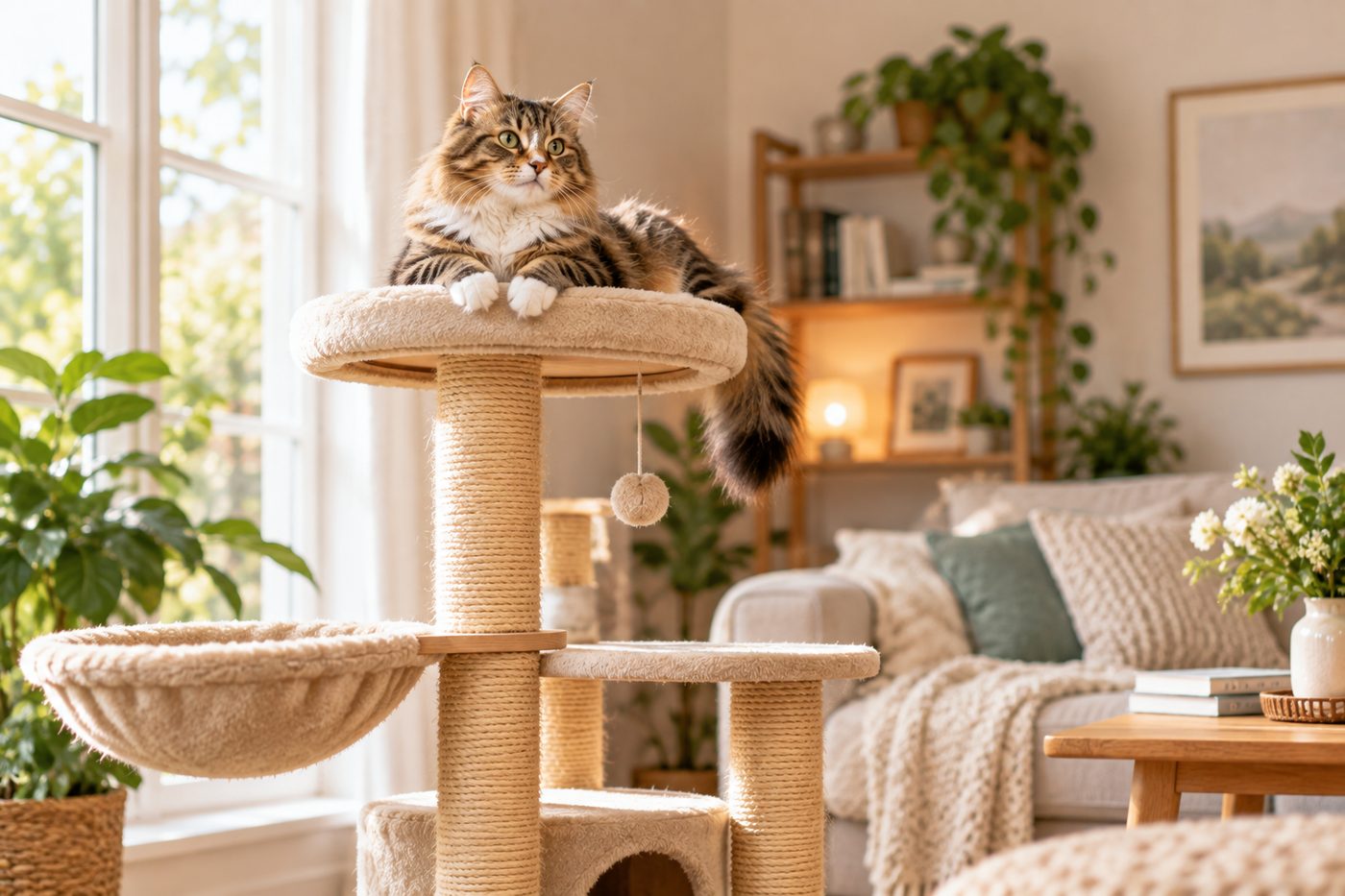
Cats seek height for a specific evolutionary reason: it gives them a safe vantage point to observe their territory, spot potential threats or prey, and retreat from stressors without confrontation. Behaviorists describe this as a core environmental need, not a quirky preference — a cat that feels it has no elevated, secure place to retreat to is more prone to stress behaviors, including some litter box avoidance and inter-cat tension in multi-cat homes.
Understanding this reframes what makes a “good” cat tree: it's not about how tall or elaborate it looks in a product photo, it's about whether it delivers a stable, elevated, secure vantage point somewhere your cat actually wants to be.
Stability First: The Single Biggest Structural Dealbreaker
A wobbly cat tree is worse than no cat tree, because a startling wobble at the top of a jump can condition a cat to avoid it entirely, sometimes permanently. Before anything else, check:
- Base weight and footprint. A heavier, wider base relative to the tree's height resists tipping significantly better than a tall, narrow design.
- Post diameter. Posts under about 3–4 inches in diameter tend to flex under a jumping cat's weight, especially for larger breeds.
- Assembly quality. Loose-fitting dowels, stripped screw holes, or particleboard that doesn't hold hardware tightly all compound into a wobble over time, even if the tree feels solid on day one.
- Floor type. A base designed for carpet can rock on hardwood or tile; check whether the tree includes rubber feet or a compatible base mat for hard flooring.
Placement: Probably the Biggest Factor in Whether It Gets Used at All
Even a perfectly stable tree gets ignored if it's placed somewhere that doesn't serve a cat's actual motivations. A spot near a window with an outdoor view (birds, activity, sunlight) consistently outperforms a corner chosen purely because it was empty floor space.
In multi-cat households, placement also needs to account for social dynamics: cats use vertical space partly as a buffer zone to avoid tension with other cats, so a tree wedged into a single high-traffic path that only one cat can access at a time can actually increase stress rather than relieve it. Multiple access points, or multiple trees in different rooms, tend to work better than one large tree everyone has to compete for.
Material Matters: Sisal vs. Carpet for Scratching Surfaces
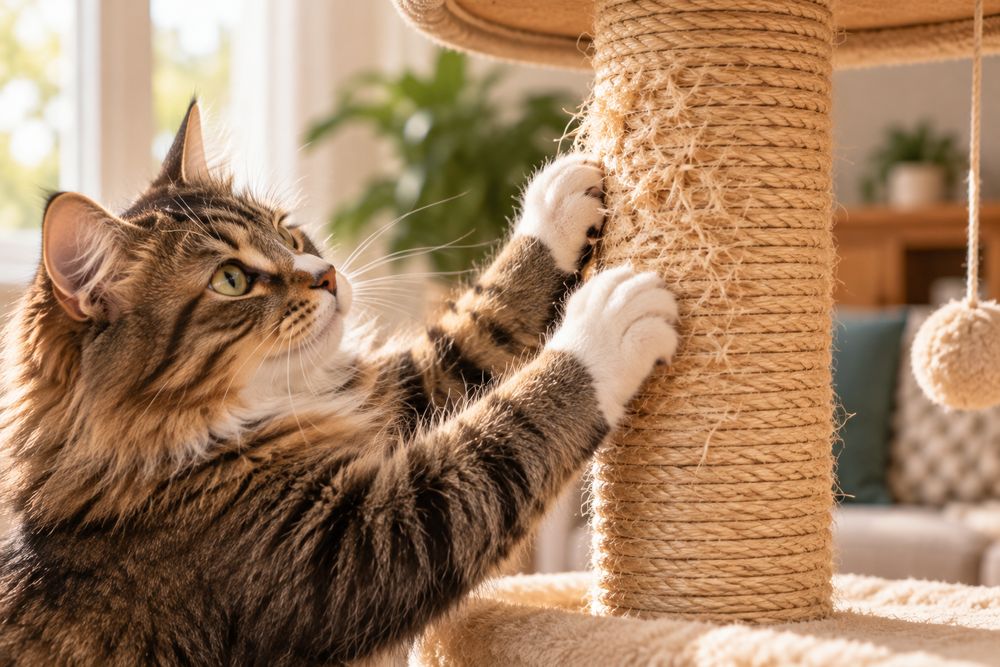
Cats scratch to mark territory and maintain claw health, and surface texture matters for whether the scratching posts on a cat tree get used instead of your furniture. Sisal rope or sisal fabric provides the rough, resistant texture cats are drawn to for a satisfying scratch; carpet-wrapped posts are often less preferred and can fray into loose loops that catch claws.
Perch height and comfort matter too: a stretch height of roughly 28–32 inches for the main platform lets most adult cats fully extend when scratching or stretching, and a perch with a slight rim or lip gives a sense of security many cats respond to compared to a flat, exposed platform.
Troubleshooting an Ignored Cat Tree
If you already own a tree that's gathering dust, work through this before assuming your cat just isn't interested:
- Test for wobble yourself by pressing down firmly on the top platform — if you can feel movement, address the base or consider anchoring it.
- Relocate it near a window or a room your cat already spends time in, rather than an unused corner.
- Add an attractant like catnip or silvervine to the top platform for a few days to build a positive association.
- In multi-cat homes, check whether one cat is guarding access and consider a second, separate elevated spot.
- Give it time — a few weeks of consistent, positive exposure is often needed before a cat fully adopts a new piece of furniture into its routine.
Sources consulted for this guide: ASPCA feline behavior resources, Cat Behavior Associates, and published research on feline scratching behavior and environmental needs. This article is for general educational purposes and is not a substitute for advice from your own veterinarian, who knows your pet's full health history.